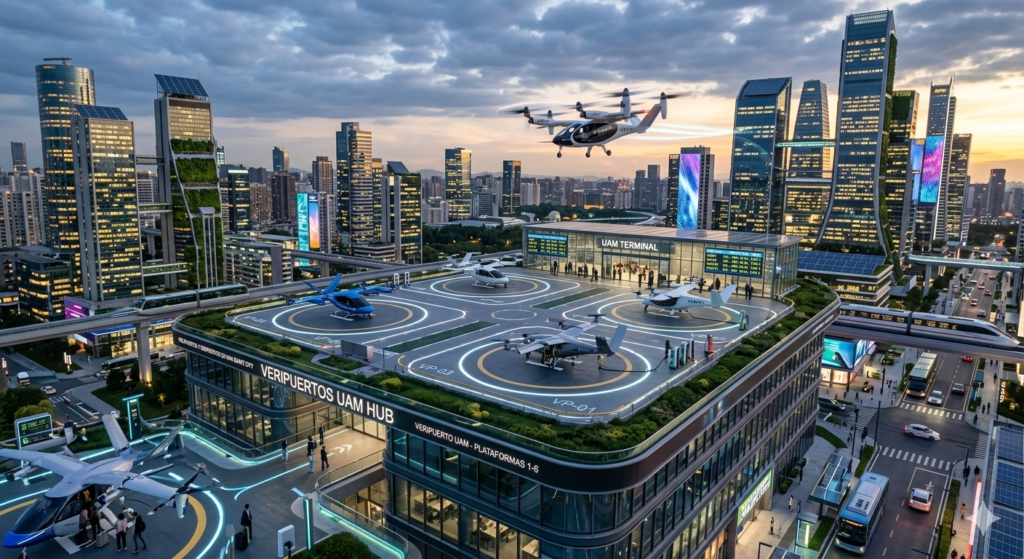
The Challenge of Urban Systems
Urban environments face several structural challenges:
- traffic congestion and inefficient mobility systems
- lack of real-time data about infrastructure usage
- fragmented digital platforms across city services
- limited predictive capabilities for urban planning.
Without integrated data systems, cities struggle to optimize mobility, energy consumption, and public services.
AI-Driven Urban Infrastructure
Artificial Intelligence enables cities to move from reactive systems to adaptive urban intelligence platforms.
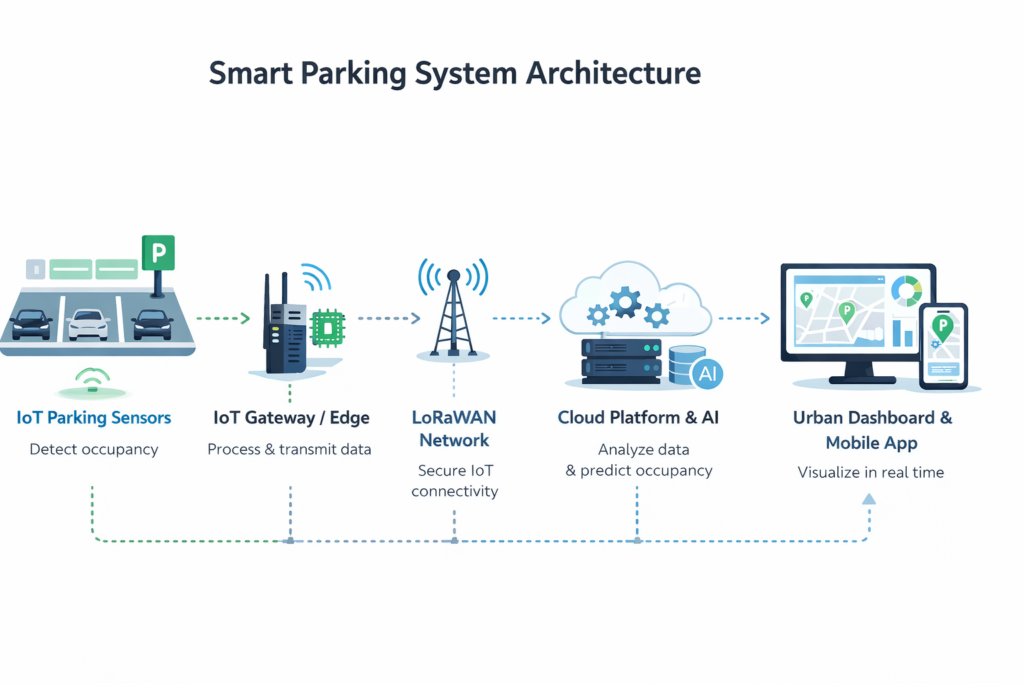
By integrating IoT sensing infrastructure with AI-driven analytics, cities can monitor and optimize urban dynamics in real time.
Typical architecture includes:
- IoT sensing infrastructure
- edge computing nodes
- cloud-based analytics platforms
- AI decision models
- urban dashboards and digital services.
This architecture allows cities to detect patterns, predict demand, and automatically adapt services
Smart Parking as a First Step
One of the most immediate applications of smart city technologies is smart parking infrastructure.
Parking congestion is responsible for a significant portion of urban traffic in many cities.
By deploying IoT parking sensors, cities can monitor parking occupancy in real time and provide data-driven services such as:
- real-time parking availability
- traffic reduction strategies
- urban mobility analytics
- integration with navigation systems.
These systems transform static parking infrastructure into data-generating urban assets.
Toward Intelligent Urban Systems
The next generation of urban platforms will combine:
- AI-driven analytics
- context-aware systems
- IoT infrastructures
- adaptive software architectures.
Such systems will enable cities to evolve toward intelligent urban ecosystems capable of optimizing mobility, sustainability, and infrastructure usage.
Closing
Developing intelligent urban systems requires collaboration between researchers, engineers, public institutions, and technology organizations.
Advancing these systems represents an important step toward more sustainable and adaptive cities.
Talk to an IoT & Urban AI Expert
If your organization is exploring AI-driven urban infrastructure, IoT systems, or smart city technologies, we would be glad to discuss potential collaboration.
Contact:
estevan.gomez@iot-bdservices.com
Services: https://iot-bdservices.com/?page_id=157